Categories
Death + Technology Death + the Web Funeral Industry

TiVo Grief with Funeral Webcasting

Funeral Webcasting – Can’t Attend a Memorial Service?
FuneralResources.com

via The Consumerist, “Now You Can Attend Funerals Live Over the Internet”

Laura Northrup at the Consumerist recently blogged about funeral webcasting with this video from Chris Hill at FuneralResources.com. Weirdly, the vid seems aimed at those in need of services for loved ones while the accompanying webpage is targeted at funeral directors (i.e., getting a funeral home set up with “Pre-Screened and Qualified™ Preferred Providers” — yes, that is actually their trademark).

Anyway, reasons for being unable to attend a funeral include being poor, old, sick or riffraff:

Specific details are scarce — I imagine it depends on the local Pre-Screened and Qualified™ Preferred Providers. Nonetheless, it seems to target those who don’t really understand how the internet works (you can watch it anywhere! even the library!). I also frown that he emphasizes that services are archived up to 90 days as though that’s a bonus and not a ripoff — you can be sure for an extra fee you can extend your access to final farewells if not purchase a DVD.

Cynicism aside, this is not a bad idea, at least for those physically unable to make it to a funeral. When it’s used as a tool of convenience, however — or as an excuse to not need to put aside differences and invite the family baddies and black sheep — the idea turns crass and cold. Funerals are about gathering and remembering together — not about watching other people gather and remember on the internet, whenever you happen to find the time to tune in and grieve.

Categories
Afterlife Death + Biology Death + Technology Death Ethics Defying Death

Mr. Freeze

Robert C.W. Ettinger

The January 25 issue of the New Yorker features an amusing article about cryopreservation of bodies, a.k.a. cryogenics or cryonics. The article doesn’t so much shed light on the science of this controversial procedure; but rather, it spotlights Robert C.W. Ettinger, one of the founders of the cryonics movement.

The ninety-one year old Ettinger gives journalist Jill Lepore a tour of his Cryonics Institute, about 20 miles northeast of Detroit. Ettinger is matter-of-fact as he dodders around the facility and explains the processes and pitfalls of cryopreservation. Ettinger’s two wives and his mother are frozen at the Institute as part of the current total of 883 members, not including the 64 pets also in cryostasis. Several pictures are here from the Immorality Institute’s forum page.

In his youth, Ettinger was a reader and writer of science fiction which informed his interest in and ultimately his career choice as a cryonicist. And indeed, he has an interesting take on what the future holds. Regarding the idea that if no one ever dies, won’t there be too many people on the planet? Ettinger posits:

The people could simply agree to share the available space in shifts and could “go into suspended animation from time to time to make room for others.” There will be no childbirth. Fetuses will be incubated in jars. Essentially, motherhood will be abolished. Then too, eugenics will help keep the birthrate down, and deformed babies could be frozen against the day that someone might actually want them.”

If you wish to learn more about Mr. Ettinger’s postulations, visit your local library or retailer and take a gander at some of his books:

Prospect of Immortality (2005)
Man into Superman (2005)
Youniverse: Toward a Self-Centered Philosophy of Immortalism and Cryonics (2009)

Categories
Burial Death + Disaster

The Last Post on Haiti’s Dead

In Haiti, A Proper Burial is in Short Supply
Frances Robles, Nadege Charles and Elinor J. Breche, Miami Herald (January 25, 2010)

This will be the last post, for a while, on the dead bodies in Haiti. I decided to run this Miami Herald article because it does a good job of summing up the problems the Haitian people are facing. None of what has happened will be resolved anytime soon and this article highlights that fact.

Categories
Afterlife cremation Death + the Law

Open Air Cremations UK Style

Funeral Pyres judgment Reserved
BBC News (January 18, 2010)

Hindu Fights for Open-Air Cremation
Metro (January 18, 2010)

Last week, a really interesting and potentially important court case appeared before a British Appeals Court. A British Hindu man, Davender Ghai, wants permission from the Newcastle City government to have his body cremated on an open air pyre, which was banned in 2006.

There are several interesting angles to this story. First and foremost, every reason that the UK Courts have given as to why the open air cremations should not go forward is suspicious. Health and safety concerns can be easily monitored and controlled. Indeed, a health and safety officer could be dispatched to make sure that the law was followed and that the public health codes were not violated.

Perhaps the most significant (and unspoken) reason that the UK Courts have sided against Mr. Ghai is squeamishness. Given the fact that any number of UK Death Professionals (and I know of which I speak) could make sure that any open air cremation followed any and every conceivable best practice, the resulting reason seems to be that Court officials find the basic concept distasteful.

Unfortunately, that is not a legal reason to ultimately block Mr. Ghai’s funeral pyre wish.

The Appeals Court is expected to rule later in 2010.

Categories
Burial cremation Death + Humor Death + the Web Funeral Industry

Video Killed the Cremation Star… or So Suggests Casket Company

Aurora Casket Company Trying to Stop Cremations with Video
R. Brian Burkhardt, YourFuneralGuy (January 25, 2010)

YourFuneralGuy just found a gem: it seems the Aurora Casket Company, one of the big three casket manufacturers in the United States, made a video of a mock funeral for direct cremation, the very villain encroaching on and slowly killing their market.

It’s dry, earnest and, well, pretty awful:

The Death of Direct Cremation from Aurora on Vimeo.

I do applaud the intention — I just hope they’re laughing, too. Whatever some marketing blog or fifteen year old told them, the internet will not save the casket industry… this time.

Categories
Burial Death + Disaster

Envisioning the Death Toll in Haiti

Haiti’s Many Troubles Keep Bodies Uncounted
Simon Romero and Neil MacFarquhar, New York Times (January 21, 2010)

Haiti quake toll ‘may be 200,000’
BBC News (January 18, 2010)

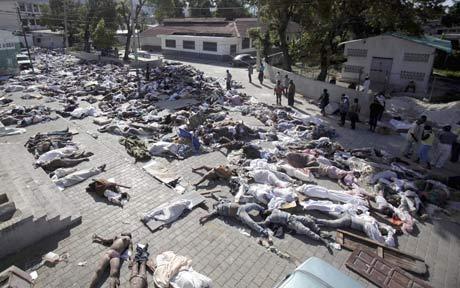
I have a hunch that for years to come, the final death toll in Haiti will remain unknown. As the tagline for the above New York Times article states: The simple truth is that no accurate death toll exists. This isn’t some keen observation on my part, rather mass fatality situations are always difficult to tabulate. And the situation in Haiti is offering up its own unique problems, such as the sheer volume of corpses, and the rapid burial of those dead bodies without any record keeping system.

During this week alone, the numbers of dead have fluctuated by several tens of thousands at a time. The BBC News article at the top quotes a US General who says the death toll may reach 200,000. That was on Monday of this week. By Thursday, the New York Times had an article which pointed out logically (if not tragically) that tabulating the death toll will be extremely difficult.

Regardless of the final, agreed upon death toll, another problem with these fluctuating body counts involves the question of human perception. In a nutshell, how can people understand a number such as 100,000 or 200,000? What do that many dead bodies look like?

I’ve thought about this question over the years, since it seems that part of the problem with any really large death toll is that it becomes so big that it can’t be envisioned.

The one way that I have figured out how to describe these numbers is by using a concept which I call the Stadium Equation. In order to understand how many bodies 100,000 or 200,000 represents, imagine yourself standing in the middle of a packed stadium. Then imagine everyone sitting around you as a dead body x the total (or projected) number of dead bodies.

This Wikipedia page lists American athletic stadiums and each stadium’s seating capacity.

In the UK, Wembley stadium (above) seats 90,000.

Categories
Death + Biology

The Population of the Dead

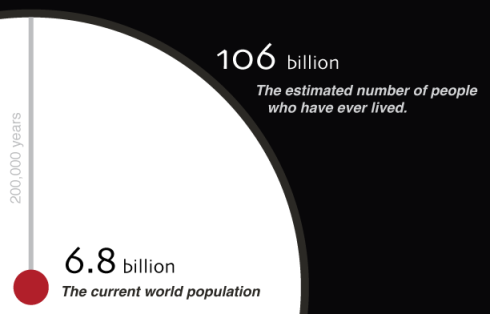
Despite the numbers of the dead being admittedly “highly speculative” in this visualization of the world’s population of the dead, I’m always a sucker for infographics. Click the image excerpt below to see the whole thing, or check out the blog post about it from the creator, Jonathan Gosier at Appfrica.

Categories
Burial Death + Disaster

The (un)Diseased Dead

Infectious Disease Risks from Dead Bodies Following Natural Disasters (pdf)
Oliver Morgan, Pan American Journal of Public Health, 2004;15(5):307–12.

In the wake of the deaths from the Haiti Earthquate — 200,000 at the most recent estimate — officials are struggling to provide appropriate and respectful body disposal. In an earlier post John mentioned the common misconception that dead bodies carry disease. Bodies are especially horrific in such quantities and conditions, with the persistent and inescapable smell of death. The otherwise natural inclination to mourn and respect the dead is overpowered by the sense of urgency to obliterate the reminder and ongoing reality of this collective trauma.

Enter mass graves: a “solution” that offers out of sight, out of mind — but little by way of preventing disease, as it’s not actually a legitimate threat to public health. A 2004 literature review (linked above) from the Pan American Health Organization on the management of dead bodies in disaster situations available offers some insight:

Victims of natural disasters usually die from trauma and are unlikely to have acute or “epidemic-causing” infections. This indicates that the risk that dead bodies pose for the public is extremely small. However, persons who are involved in close contact with the dead — such as military personnel, rescue workers, volunteers, and others — may be exposed to chronic infectious hazards, including hepatitis B virus, hepatitis C virus, HIV, enteric pathogens, and Mycobacterium tuberculosis. Suitable precautions for these persons include training, use of body bags and disposable gloves, good hygiene practice, and vaccination for hepatitis B and tuberculosis. Disposal of bodies should respect local custom and practice where possible. …

Concern that dead bodies are infectious can be considered a “natural” reaction by persons wanting to protect themselves from disease. However, clear information about the risks is needed so that responsible local authorities ensure that the bodies of disaster victims are handled appropriately and with due respect.

An editorial in the same journal issue (“Epidemics Caused by Dead Bodies: a Disaster Myth That Does Not Want to Die”) argues that expedient mass burial does have an effect on public health — not by preventing disease, but by exacerbating grief and endangering mental health:

Denying the right to identify the deceased or suppressing the means to track the body for proper grieving adds to the mental health risks facing the affected population.

It’s hard to say what has a worse impact over time: being surrounded by unburied, dead strangers for an extended period, or never being able to find the body of a deceased loved one. I’m willing to bet the latter.

Categories
Burial Cemeteries Death + Disaster

Haiti’s Anonymous Dead

As Haitians Flee, the Dead Go Uncounted
Damien Cave, New York Times (January 18, 2010)

Last home of country’s most famous families turns from place of respect and mourning into installation of horror
Ed Pilkington, The Guardian (January 18, 2010)

Following up on yesterday’s Haiti earthquake post, these New York Times and Guardian articles expand upon the rushed burial of the dead.

Categories
Burial Cemeteries Death + Disaster

The Impossibility of Identifying the Dead in Haiti

How can a country in the grip of an apocalyptic tragedy deal in a dignified way with its victims?
Paul Harris, The Guardian (January 17, 2010)

The current stories emanating from Haiti are incomprehensibly awful. This Guardian article uses the word apocalyptic and that seems utterly appropriate.

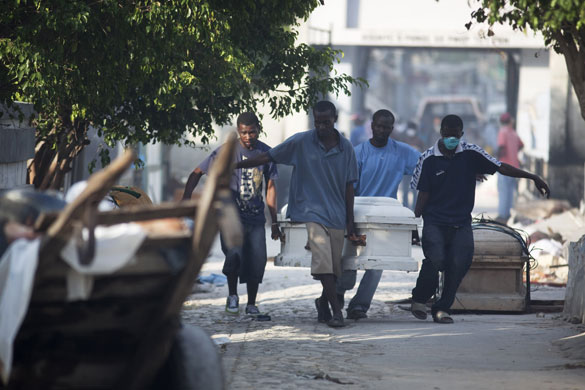
A crisis situation of this enormity is compounded by the sheer number of immediate human needs. One of those key requirements is the rapid identification, removal, and burial of dead bodies. The problem in Haiti is that an already weak infrastructure is unable to handle the number of dead bodies produced by the earthquake. In this crisis situation, the normalized rules for handling the dead cannot cope with all the corpses.

And yet, something must be done with the dead bodies.

Part of the assistance being sent by the United States involves dispatching Disaster Mortuary Organizational Response Teams or DMORT groups to Haiti. DMORT is part of the US Department of Health and Human Services and specializes in handling mass fatality situations. These are the kinds of individuals on DMORT Teams (as listed on the HHS website):

funeral directors, medical examiners, coroners, pathologists, forensic anthropologists, medical records technicians and transcribers, finger print specialists, forensic odontologists, dental assistants, x-ray technicians, mental health specialists, computer professionals, administrative support staff, and security and investigative personnel.

Here is an article about a University of Florida Forensic Entomologist, Dr. Jason Byrd, who is already in Haiti with a DMORT group.

Private companies are also sending groups to Haiti. The main provider of mass disaster/fatality services in the private sector is Kenyon International Emergency Services. Kenyon is based in Houston, TX and owned by Service Corporation International (SCI). SCI is the largest global provider of funeral, cemetery, and cremation services and got into the mass fatality business in the mid-2000’s. I will write more about SCI and Kenyon at a later date.

For right now, both DMORT and Kenyon will be attempting to do the following things:

1.) Identify any of the dead that they can
2.) bury the dead in an organized fashion
3.) use a tagging system of some kind so that the dead can be (possibly) identified at a later date.

These tasks are made vastly more complicated by the rush to bury bodies in mass graves. There is a common misconception that dead bodies spread disease. That’s not entirely true and this CNN article covers these points. What dead bodies do create is a terrible smell. Decomposing dead bodies are also difficult to look at. When you multiply these problems by 100,000 dead bodies (this is just the body count estimate at this point) then immediate disposal of the corpses becomes easier to understand.

The following video clip from CNN sums up the situation:

Categories
Death + the Law Death Ethics

Live Free and Die in Montana

Ruling by Montana Supreme Court Bolsters Physician-Assisted Suicide
by Kirk Johnson, New York Times (January 10, 2010)

Last September I posted an article on a Montana man who took his right-to-die case to the Montana State Supreme Court. The case involved 76-year old Robert Baxter who, sadly, died of leukemia before the case made it to the court. I say sadly because it’s clear that Mr. Baxter felt strongly about an individual’s inalienable right to both die on his or her own terms AND to seek out medical assistance with that death.

The Montana State Supreme Court mostly agreed with Mr. Baxter, saying that the current state law does enable doctors to assist with dying BUT the court declined to state that physician-assisted suicide is a Constitutional right.

Here are more articles on the case:
Washington Post: Montana 3rd state to allow doctor-assisted suicide

Christian Science Monitor: Montana becomes third state to legalize physician-assisted suicide

We will see more of these assisted dying cases in the years to come. This much I know.

Categories
Death + Biology

Corpse Flower Blooms in Milwaukee

Corpse flower to Bloom at Milwaukee Museum
Associated Press (January 12, 2010)

It seems only too fitting. That a seven-foot tall Sumatran “Corpse Flower” will soon bloom at the Milwaukee Public Museum. I’m from Wisconsin so I can make all the jokes I want.

Oddly (or perhaps not so oddly) it turns out that the Corpse Flower has made its way into the Death Reference Desk before. Last September, Death Ref Superstar Kim wrote the following:

The fascinating and frighteningly named “Corpse Flower” or amorphophallus titanum, as it’s scientifically known, will affront your sense of smell like no other plant on earth. Indigenous to the tropical forests of Sumatra (but grown in a few horticultural centers stateside), the Corpse Flower emits a rotten flesh smell that has people gagging for air within 10 feet of it.

You can read the whole post on death and smell here.

So remember everyone: when you go to Milwaukee don’t 1.) drink the water and 2.) don’t get within 10 feet of the local Amorphophallus titanum after lunch.